
What are the benefits of whey protein?
Whey protein shakes are particularly popular among athletes who want to recover after a strenuous workout. The amino acids contained in the powder stimulate protein synthesis and provide the muscles with additional energy.
When considering what whey protein is good for, it can be stated that as a high-quality protein source, it can support muscle building and that whey protein can have a positive effect on lowering blood pressure[¹], blood lipids[²], and diets[⁴] .
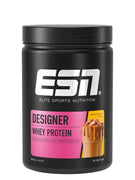
For the effects of whey protein to become visible, the correct dosage is important. The optimal dosage depends on your goals – depending on whether you value muscle building, muscle maintenance, or dieting . Ideal are 30 grams of powder per serving, which is also the dosage recommendation for our ESN Designer Whey. However, when calculating your personal protein requirements, you should also take into account the intake of protein from other protein sources in your diet.
If you consume too much whey protein, it can lead to digestive problems. These are often associated with lactose intolerance.[⁵] Learn more about the topic of Whey Protein and Lactose.
Excellent Source of High-Quality Protein
The basis for whey protein is the whey protein of milk. Whey powder is available in different qualities and forms. The forms are whey concentrate, whey protein isolate and whey hydrolysate.
Whey protein is a high-quality protein that contains all essential amino acids [⁶] The body can digest it well, and compared to other types of protein, it is quickly absorbed from the intestine.[⁷] All these properties make whey protein one of the best protein sources for you.
What are the benefits of whey protein for muscle building?
Your body changes over the years, especially muscle mass decreases with age.[⁸] With a combination of strength training and proper nutrition, this process can be partially slowed down, prevented, or even reversed: strength training in combination with the consumption of high-protein foods or protein supplements has proven to be an effective prevention strategy [⁹]
High-quality protein sources, such as whey, are particularly effective because they are rich in the branched-chain amino acid leucine . Thanks to leucine, whey protein has an anabolic effect – leucine is the amino acid that most strongly promotes muscle building.[¹⁰]
Whey protein can help lower blood pressure
Severely elevated blood pressure (hypertension) is one of the most common risk factors for heart disease.[¹¹] With a balanced diet, you can counteract this risk: for example, the consumption of whey protein can have a positive effect on blood pressure. Numerous studies have linked the consumption of products containing milk with a reduction in blood pressure [¹²] [¹³]
For example, one study involving overweight individuals showed that taking whey protein (54 grams per day for 12 weeks) lowered systolic blood pressure by 4 percent . Other milk proteins such as casein had similar effects.[¹⁴]
Whey protein can have a positive effect on blood lipid levels
Whey protein can also have an effect on blood lipid levels . High cholesterol levels, especially LDL cholesterol, are a risk factor for heart disease.[¹⁵] In a study involving overweight individuals, taking 54 grams of whey protein per day for 12 weeks led to a significant reduction in total and LDL cholesterol (the "bad" cholesterol) in the body.[¹⁶]
Other studies found no similar effects on blood cholesterol levels, but the lack of effect could also be due to differences in study design.[¹⁷] [¹⁸] Before definitive conclusions can be drawn, further studies are required.
Does whey protein keep you full longer?
Whey protein shakes are popular not only for muscle building. Taking whey protein can also have a positive effect on dieting, because whey in the form of powder or protein shakes can help you stay full longer.
Some foods are more filling than others: an effect that is partly due to their macronutrient composition (protein, carbohydrates, fat). Protein is by far the most filling of the three macronutrients.[¹⁹] However, not all proteins have the same effect on satiety. Whey protein appears to be more filling than other types of protein, such as casein and soy protein.[²⁰] [²¹]
These properties make it particularly useful for those who want to eat fewer calories and lose weight – protein shakes are suitable for weight loss and are therefore interesting not only for athletes.
Who benefits most from the effects of whey protein?
Generally, taking whey protein is suitable for anyone who cannot sufficiently cover their protein intake through their diet and therefore wants to supplement it with protein powder & Co. However, regular consumption of whey protein in the form of protein powder is particularly suitable for hard-training athletes who want to replenish their protein stores after training.
Do the different types of whey protein have different effects?
All whey proteins basically have the same effect, but differ in their properties:
- Whey Protein Concentrate (WPC): The whey protein concentrate is produced from whey through a special filtration process. It is the most affordable whey protein variant. The protein content of whey protein concentrate is between 70 and 80 percent, with a low fat and carbohydrate content. Because of simple filtration, the concentrate still contains a relatively high amount of lactose, which can have a negative effect on digestibility. In ultrafiltered whey protein , the lactose, then the fat and finally the minerals are removed from the whey protein. This creates a very high-quality protein with a low lactose and fat content, but a very high protein content.
- Whey Protein Isolate (WPI): The isolate contains between 90 and 96 percent protein and is obtained through a microfiltration process. Whey protein isolate contains significantly less lactose, fat, and carbohydrates than WPC. It is therefore well suited for a low-carbohydrate diet. The production of the isolate is considerably more complex and more expensive than whey protein concentrate, which is why it also costs slightly more. The extra cost is worth it: due to the even shorter protein chains, the isolate is available to the body within just a few minutes .
- Whey Protein Hydrolysate (WPH): The hydrolysate is obtained from whey protein isolate by breaking down the enzymes (hydrolysis). In this process, the building blocks of the protein are broken down into their smallest components: the peptides. They can be absorbed by the body even faster and more efficiently. The hydrolysate has a very complex production process and is therefore more expensive. The hydrolysate also has a relatively bitter taste, which is why it is not as popular as whey protein concentrate or isolate.
Does whey protein have side effects?
Now you know what whey protein is good for, but does it also have side effects ? The only side effects that can occur with whey protein are reactions due to an "overdose". These are usually digestive problems such as bloating, stomach cramps, or diarrhea – caused by the intolerance of the lactose contained in whey protein.[²²] People with a cow's milk allergy must also exercise caution – allergic reactions can occur due to the milk contained in whey. Learn more about the side effects of whey protein.
It is best to always follow the recommended intake on the protein powder packaging and remember not to exceed the daily protein intake of around 2 grams per kilogram of body weight .[²³]
Conclusion on the effects of whey protein
Ultimately, whey protein is not only a convenient way to increase protein intake, it can also have some health benefits – whether for supplying the muscles during muscle building, during a diet, or for positively influencing blood lipid levels and lowering blood pressure.
To benefit from the effects of whey protein as a shake or powder in food, you should also pay attention to the quality of the protein powder . Only buy high-quality protein powder and make sure that it ideally has a high protein content. No matter what purpose you want to use protein powder and whey protein for: ESN has the right whey protein for every personal goal!
Sources:
[1] https://pubmed.ncbi.nlm.nih.gov/19369377/
[2] https://pubmed.ncbi.nlm.nih.gov/18259007/
[3] https://pubmed.ncbi.nlm.nih.gov/19893505/
[4] https://pubmed.ncbi.nlm.nih.gov/18469287/
[5] https://www.sciencedirect.com/science/article/pii/B9780128097625000164
[6] https://www.ncbi.nlm.nih.gov/pmc/articles/PMC3905294/
[7] https://pubmed.ncbi.nlm.nih.gov/9405716/
[8] https://www.ncbi.nlm.nih.gov/pmc/articles/PMC6442923/
[9] https://pubmed.ncbi.nlm.nih.gov/19057193/
[10] https://pubmed.ncbi.nlm.nih.gov/16365087/
[11] https://www.ncbi.nlm.nih.gov/pmc/articles/PMC8162166/
[12] https://pubmed.ncbi.nlm.nih.gov/19369377/
[13] https://pubmed.ncbi.nlm.nih.gov/18259007/
[14] https://pubmed.ncbi.nlm.nih.gov/19893505/
[15] https://www.ncbi.nlm.nih.gov/pmc/articles/PMC6813799/
[16] https://pubmed.ncbi.nlm.nih.gov/19893505/
[17] https://www.sciencedirect.com/science/article/abs/pii/S095869461000141X
[18] https://pubmed.ncbi.nlm.nih.gov/19153580/
[19] https://pubmed.ncbi.nlm.nih.gov/18469287/
[20] https://pubmed.ncbi.nlm.nih.gov/19385022/
[21] https://pubmed.ncbi.nlm.nih.gov/24801369/
[22] https://www.sciencedirect.com/science/article/pii/B9780128097625000164
[23] https://examine.com/guides/protein-intake/#how-much-protein-do-you-need-per-day
